
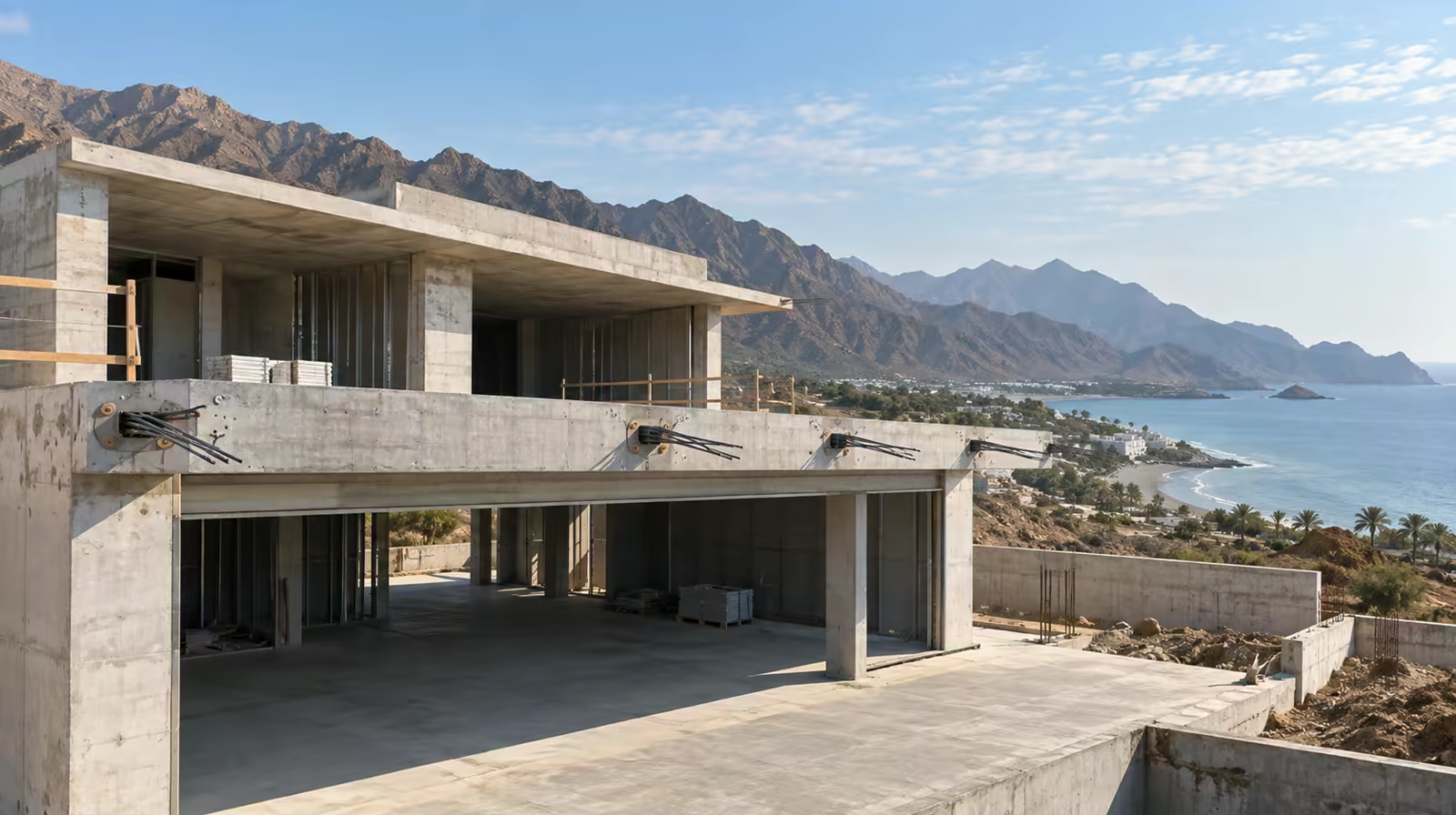
Not because the engineering changes. A 10 metre span in Fujairah behaves exactly as a 10 metre span in Ajman. What changes is that a crew and equipment have to cross a mountain range to get there, and on a project with a single slab that cost cannot be spread across anything. The result is that the threshold at which post-tensioning becomes worth it on a villa sits higher in Fujairah than almost anywhere else in the UAE.
Why Does Geography Change the Answer?
Because mobilisation is a fixed cost and a villa is a small project.
On a mid-rise building, bringing a crew and equipment to site is spread across thousands of square metres and multiple floor cycles. On a villa it lands on one or two slabs, the arithmetic our guide to villa post-tensioning covers in full, and it applies everywhere.
Fujairah adds distance to it. The journey from the western emirates crosses the Hajar range, so it is not simply longer in kilometres, it is longer in time and harder to repeat casually. A query that would prompt a quick site visit elsewhere becomes a planned trip. Returning for a second short operation is a decision rather than a detour.
That does not make villa post-tensioning in Fujairah unworkable. It means the structural benefit has to be larger to justify it, and it makes the initial assessment more important, because getting the design right first time matters more when revisiting is expensive.
Which means the threshold moves rather than the physics
Elsewhere in the UAE, a villa with a 9 metre clear span is a reasonable candidate for post-tensioning.
In Fujairah, a span at that margin is more likely to be better served by a downstand beam, a deeper reinforced concrete slab, or a repositioned column. The structure would work either way. The economics tilt differently.
Where the span is genuinely long, where a cantilever is central to the architecture, or where several elements in the same villa need it, the case holds regardless of distance. One decisive requirement justifies the mobilisation. A marginal one does not.
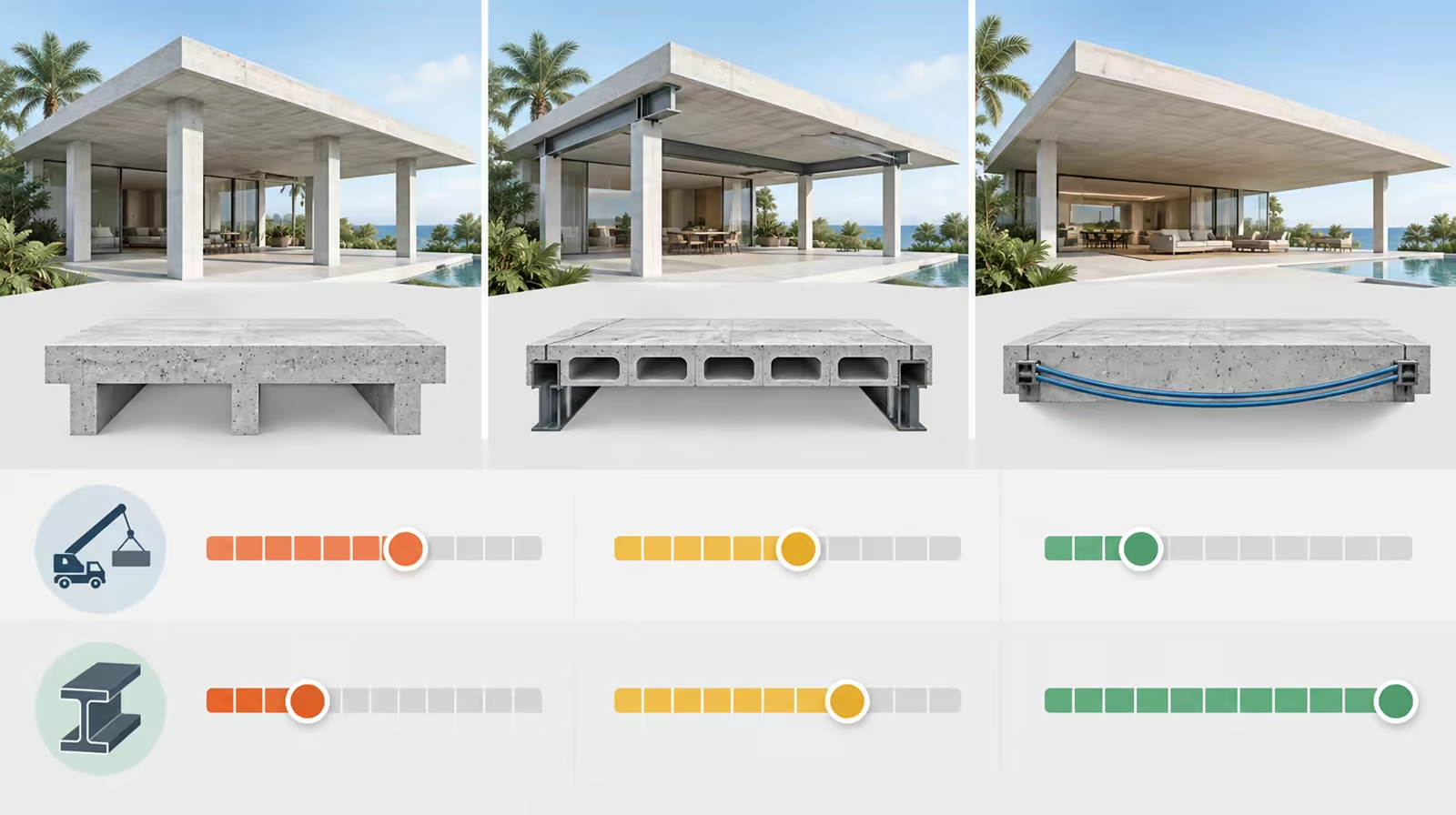
Distance does not change the physics. It changes the span at which post-tensioning starts to pay for itself.
What Do Fujairah Villas Actually Ask For?
The terrain shapes the architecture, and the architecture shapes the structure.
Views, and the openness that serves them. A villa positioned for a sea view or a mountain outlook is usually designed to open toward it. Large glazed elevations, terraces oriented at the view, and living spaces intended to read as continuous with the outside. Columns interrupt exactly what such a house is organised around.
Cantilevers and level changes. On sloping ground, upper floors that project, terraces that oversail, and split levels are common architectural responses. Cantilevers are deflection problems, and controlling deflection is what prestress does directly.
Roof terraces. In a location with a view worth using, roofs are frequently occupied, sometimes carrying planting, a pool or a shaded majlis, over spans set by the rooms below.
Wadi and drainage considerations. Fujairah's terrain includes wadis that carry water seasonally. This affects siting, foundations and drainage rather than the post-tensioning directly, but it belongs in any honest discussion of building there, and it is a reason ground conditions deserve early attention.
What Does the Coastal Position Add?
The same exposure considerations that apply anywhere on the UAE coast: humidity, airborne chlorides, and for a house near the shore an aggressive environment for any embedded steel.
For a post-tensioned element that means cover to the ducts, crack width control, complete grouting and properly sealed anchorages all matter as much on a villa as on a larger building, the same protection covered in more depth in our guide to coastal durability. The structure is smaller. The chemistry is identical.
The difference is who looks after it. A commercial building has a facilities team and a maintenance budget. A private house has an owner who may never think about the structure again, which makes getting the protection right at construction more important rather than less, because nothing will be inspected later.
What Should You Settle Before Asking for a Price?
Which spaces genuinely require no columns, distinguishing requirement from preference. This changes the answer more than anything else.
Whether the flat ceiling is essential, because if a downstand beam is architecturally acceptable, it is very likely the better answer here.
All the long-span elements at once. If the villa has a large living space, a cantilevered terrace and an occupied roof, they should be assessed together. Several elements justify one mobilisation far more comfortably than one does.
The ground conditions and site access. Both affect the practicality and the programme, and both are worth knowing before anyone prices structural options.
Send that with the architectural plans and it is usually possible to give a well-founded view without a site visit, which on a Fujairah project is a saving in itself.
Our project record is mid-rise residential and mixed-use buildings in Ajman, with slab thicknesses between 220mm and 280mm on repeated floor plates. That is a different proposition from a single villa slab, and the reason we set out the mobilisation arithmetic plainly is that we would rather tell you at enquiry stage that the numbers do not work than after a quotation has been prepared.
Explore our Post-Tension Design service, or see how we work across the emirate on our Post-Tensioning in Fujairah page.