
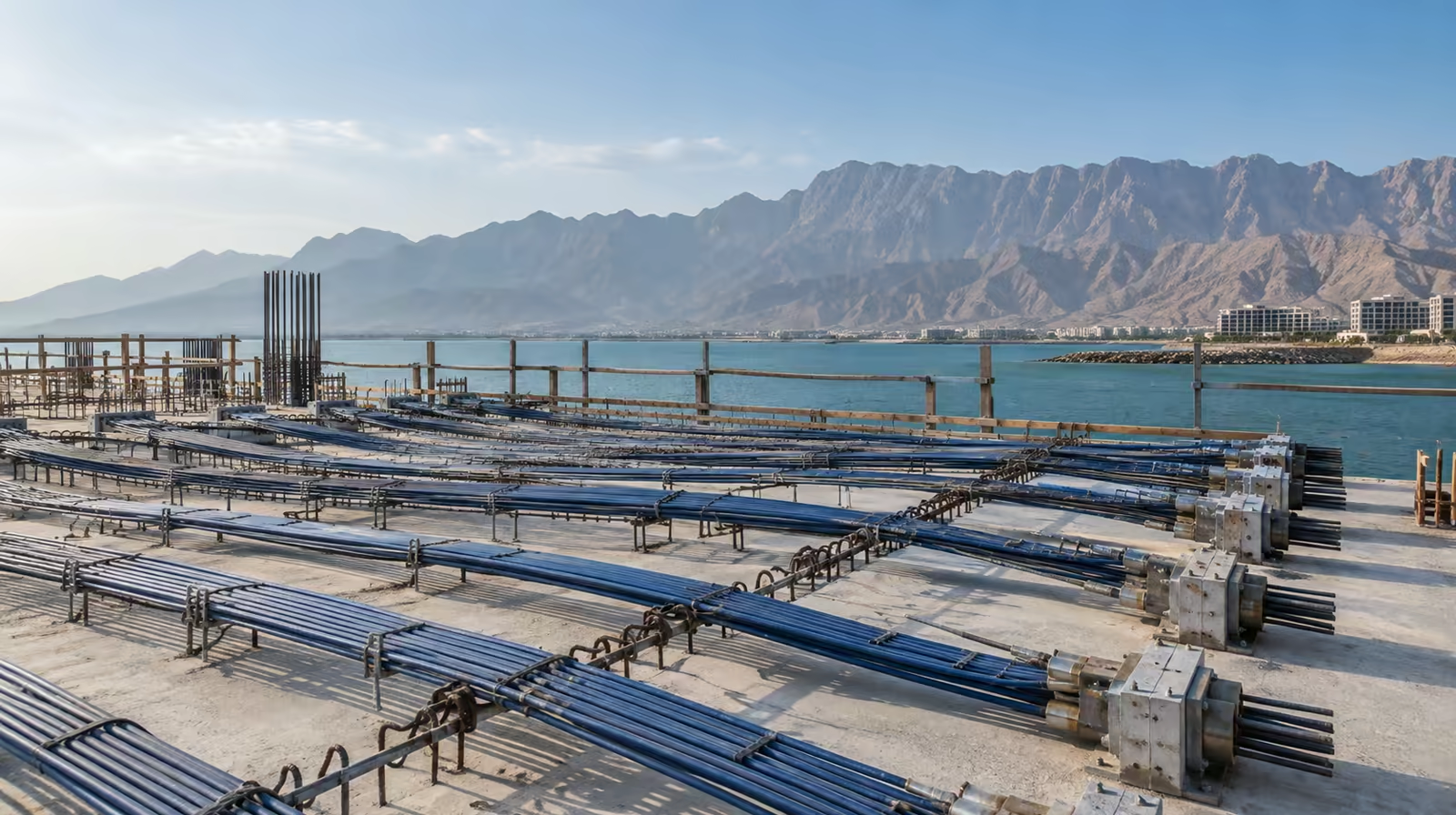
That is the difference coastal work makes to installation, and it is almost entirely about the period between delivery and grouting.
What Happens to Materials Before They Are Installed?
They deteriorate faster than most people plan for.
Strand arrives as bright steel. In a coastal, humid environment, surface rust forms quickly. Light surface oxidation is generally acceptable and is a normal condition on any site. Pitting is not, because a pit is a stress concentration on a component that will spend its life at very high stress. The distinction matters and it is a judgement made by someone who has seen both.
Anchorages and wedges are the components most vulnerable to being written off by poor storage. Wedges grip the strand through fine teeth, and corrosion on those teeth compromises the grip. They are small, easily left in a corner of a compound, and easily ruined.
Duct is more robust but not immune. Damaged or corroded duct, or joints that have deteriorated, become the route by which grout escapes or concrete intrudes.
The practical answer is unglamorous and effective: covered storage off the ground, materials scheduled to arrive close to when they are needed rather than early, wedges and anchorages kept in sealed packaging until the day, and a delivery inspection that actually looks at condition rather than counting boxes.
Which makes just-in-time scheduling a technical decision rather than a commercial one
On an inland site, ordering post-tensioning materials early is prudent. On a coastal site it means storing vulnerable steel in an aggressive environment for longer.
That flips the usual logic. The material scheduling on a waterfront project should be tighter, not looser, and it is one of the clearest arguments for supply and installation sitting with the same party. Where a contractor procures material separately and it arrives whenever the supplier delivers, nobody owns the storage duration.

The window between delivery and grouting is exposure time, and on the coast it costs more.
What Changes About the Installation Window?
The period between tendons being laid and the duct being grouted is exposure time, and on the coast it costs more.
Between installation and the pour, tendons sit on an open deck. Between the pour and stressing, the duct interior is sealed at the ends but the anchorages are exposed. Between stressing and grouting, the tendon is inside a duct that is open at the anchorages, in an environment full of salt-laden moisture.
None of that is unique to the coast. What is different is how quickly the environment does damage, which means the practical rule is to compress the sequence: install close to the pour, stress as soon as transfer strength is confirmed, and grout promptly rather than when convenient.
A gap of several weeks between stressing and grouting is undesirable anywhere. On a waterfront site it is the single worst thing that can happen to the tendons before the building is finished.
What Do Waterfront Sites Do to Logistics?
They constrain everything, and the constraints are worth planning around rather than discovering.
Access is frequently single-route. An island, a reclaimed peninsula or a site reached by a causeway has one way in. A delivery that misses its window may not simply arrive later, and equipment that has to leave for maintenance is off site for longer.
Storage area is limited. Waterfront plots are valuable and often tight, which combines badly with the need for covered storage.
Weather stops work more often. Wind matters on an exposed coastal site, and a stressing operation is not something to conduct in conditions that compromise safe working.
Groundwater is high and saline. For anything below ground, this affects the concrete and the construction sequence more than the post-tensioning directly, but it shapes the programme the post-tensioning has to fit.
The cumulative effect is that a coastal project rewards planning and punishes improvisation more than an inland one does.
What Should Be Agreed Before Mobilising?
Delivery scheduling tied to the pour programme, not to procurement convenience, with the storage duration explicitly minimised.
Covered, off-ground storage identified on the site plan rather than assumed.
A committed stressing-to-grouting interval, stated as a target rather than left to sequence itself.
Delivery inspection criteria agreed, so that the difference between acceptable surface oxidation and unacceptable pitting is decided in advance rather than argued about on the day.
Access windows confirmed where the site has constrained routing.
None of this is unusual practice. It is ordinary good practice made non-negotiable by the environment.
Our project record is in Ajman, itself a coastal emirate, where the same humidity and airborne chloride conditions apply to material storage and to the interval between stressing and grouting. Our standard material specification has been 12.7mm strand with flat slab anchorages and smooth flat duct, and supply sits within the same scope as installation, stressing and grouting, which is what makes the delivery-to-grouting sequence controllable rather than dependent on another party's programme.
Explore our Installation service, or see how we work across the emirate on our Post-Tensioning in Ras Al Khaimah page.