
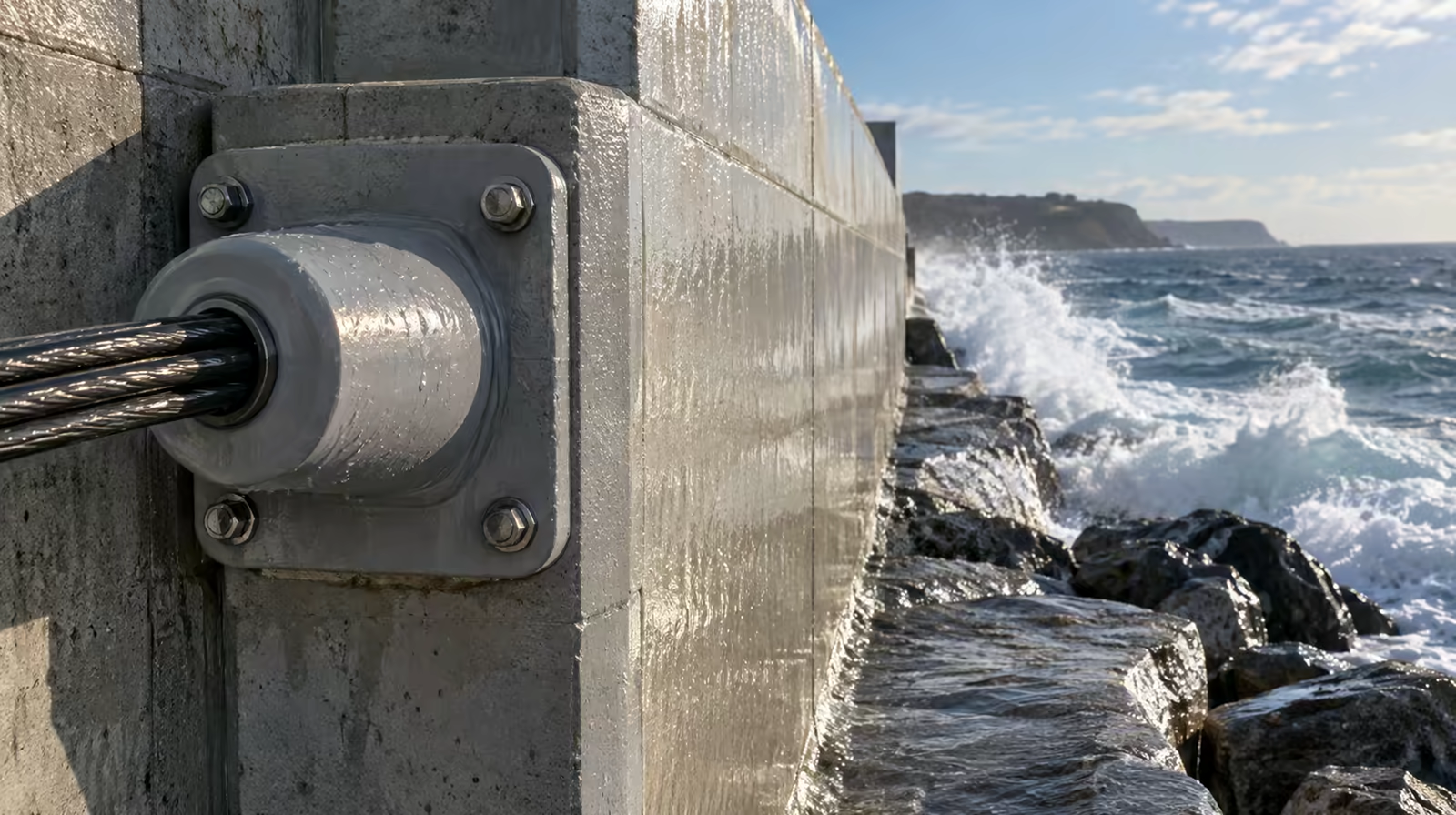
On a coastal site in Ras Al Khaimah, with humidity, airborne chlorides and often saline groundwater, the barrier is under continuous attack for the life of the building.
How Do Chlorides Actually Reach the Tendons?
Three routes, and they are not equally likely.
Through sound concrete, slowly. Chlorides diffuse through the concrete matrix over years. This is the mechanism the cover depth and the concrete quality are designed against, and on a well-built structure it is a decades-long process.
Through cracks, quickly. A crack is a direct path. This is why crack width control matters so much more in a marine environment than inland: it is not an appearance question, it is the difference between diffusion over decades and ingress in seasons.
Through failed details, immediately. Waterproofing that has failed, a drainage outlet that is blocked, an anchorage pocket that was never properly sealed, a construction joint that leaks. This is by far the most common route in practice, and it is entirely a workmanship and maintenance issue rather than a materials one.
The third route causes most real problems. That is worth knowing, because it means coastal durability is determined more by detailing and maintenance than by anything exotic in the concrete specification.
And then the tendon has a second line of defence
On a bonded post-tensioned structure the tendon sits inside a grouted duct, so chlorides reaching the duct still have the grout to get through.
Where the grouting is complete, that is a genuinely robust barrier. Where there is a void, it is nothing at all, and the void is precisely the environment corrosion prefers: enclosed, humid, unprotected steel.
This is why grouting quality is a durability issue rather than a construction detail, and why it matters most on exactly the buildings where it is hardest to verify afterwards.
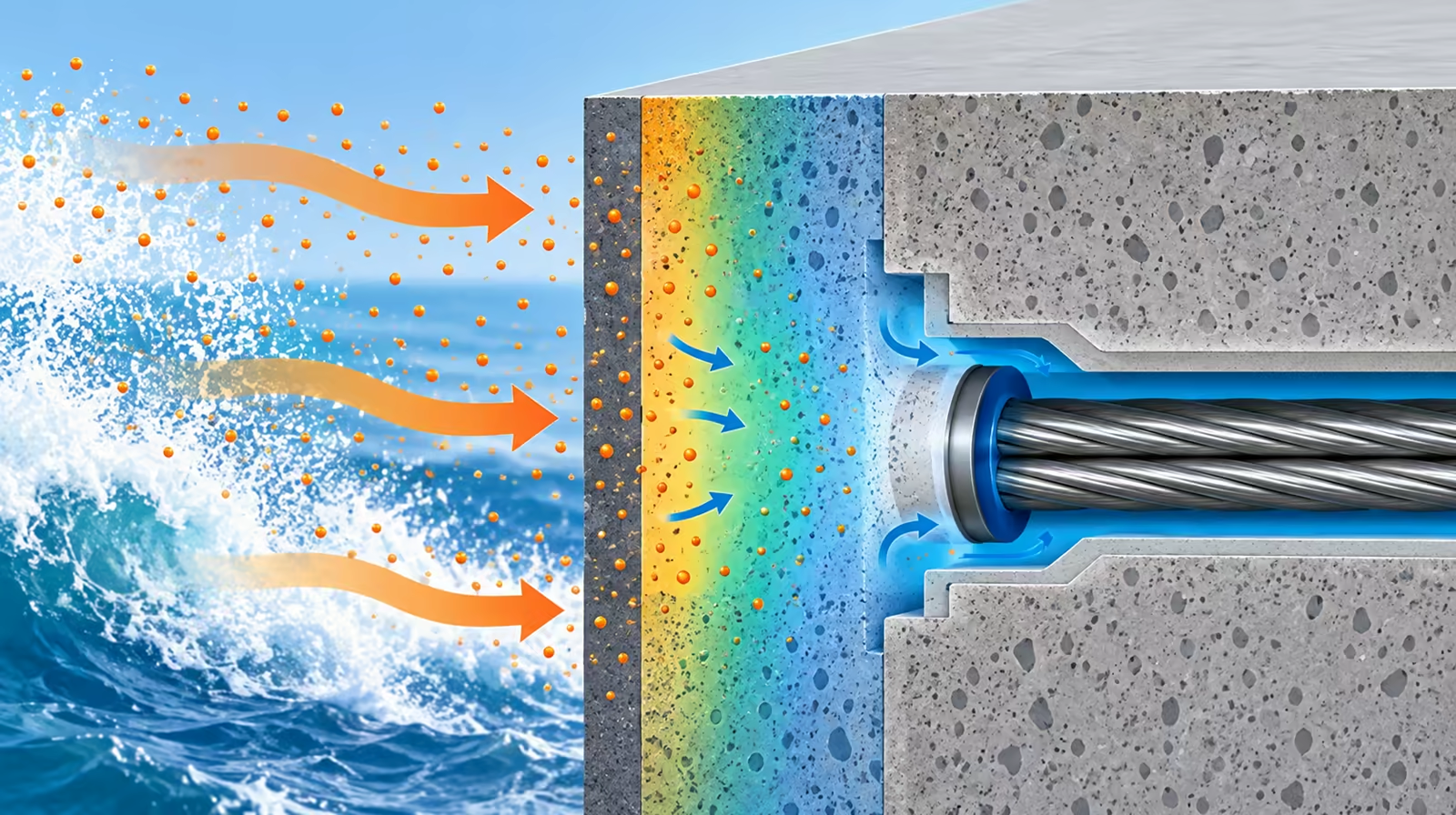
Protection is layered: cover and concrete quality first, then crack control, then the grout itself.
What Does the Design Actually Do About It?
Four things, in roughly descending order of how much they matter.
Cover. More concrete between the surface and the steel means a longer diffusion path. Coastal exposure classifications require greater cover than inland ones for exactly this reason, and it is the single most effective provision.
Concrete quality. A denser, less permeable mix slows diffusion. Achieved through mix design and, critically, through curing. Concrete that dried rather than cured in UAE heat is more permeable than its specification suggests, which is a real risk in this climate.
Crack width limits. Tighter in marine exposure. Post-tensioning helps here directly, since precompression means the concrete has to overcome the prestress before a crack can open at all. This is one of the genuine durability advantages of post-tensioning in a coastal environment, as distinct from its structural advantages.
Detailing. Waterproofing systems specified and detailed rather than assumed, drainage that works and can be maintained, anchorage pockets sealed properly, joints detailed to shed water rather than collect it.
What Should an Owner Actually Do?
Far less than most durability advice implies, but consistently.
Keep the water moving. Blocked drainage is the most common cause of avoidable deterioration on any structure and it is trivially cheap to prevent. Water standing on a deck or against a slab edge has time to find a way in.
Inspect the slab edges and anchorage zones. This is where problems appear first and where they are visible without equipment. Rust staining at a slab edge is the earliest reliable warning available and it can be seen from ground level.
Maintain the waterproofing. Every waterproofing system has a finite life, considerably shorter than the structure's. Treating it as a permanent installation rather than a maintained one is how a fifty-year structure develops a problem at year eighteen.
Record what you see, with dates and photographs. A crack that has been the same width for five years is a different thing from one that has grown. Without a record, nobody can tell which they are looking at.
Do not core or drill without locating the tendons. Applies at every stage of the building's life, and comes up during every refurbishment.
That is a maintenance regime, not a monitoring programme, and it is within the capability of any competent facilities team.
When Does This Become an Investigation Rather Than Maintenance?
When any of the following appear: rust staining at slab edges or anchorage pockets, spalling or concrete sounding hollow, cracking that follows the tendon lines or is measurably widening, deflection that keeps increasing, or persistent water ingress through the slab.
Exposed strand or a blown-out anchorage pocket is not an inspection item. It is an immediate call.
The general principle for coastal structures is that early investigation is disproportionately worth it. A protection problem caught while it is still a protection problem can often be repaired by restoring the protection. The same problem found once the strand has lost section is a considerably larger intervention.
Our own work is new-build post-tensioning in Ajman, a coastal emirate with the same exposure conditions, which is directly relevant to assessment: most durability problems in post-tensioned structures originate as construction-stage defects, whether a void left in a duct, an anchorage never properly sealed, or cover that was not achieved. Knowing what should have happened during construction is what makes it possible to work out what did.
Explore our Repair and Rehabilitation service, or see how we work across the emirate on our Post-Tensioning in Ras Al Khaimah page.