

On a conventional reinforced concrete frame, cube results are largely a record. On a post-tensioned frame, they decide when the next stage can begin. On inspection and testing work we carry out across the UAE, this sequence is what keeps a floor cycle moving without ever stressing against concrete that is not ready.
Why Does a Post-Tensioned Slab Care So Much About Concrete Strength?
Because of what happens at the anchorages.
When a tendon is stressed, its entire force is transferred into the concrete through a small anchorage casting. The stress in the concrete immediately behind that anchorage is very high, far higher than anywhere else in the slab. Concrete that has not reached adequate strength crushes locally in that zone.
That is why the governing figure is not the 28 day design strength but a transfer strength: the strength required at the moment of stressing, specified for the project and usually a proportion of the final design strength. The slab does not need to be at its full strength to be stressed. It needs to be at the strength the anchorage zone requires.
The practical consequence is a set of cubes cast specifically to be tested at the transfer point, cured alongside the slab so they represent it, rather than relying on the standard 7 and 28 day set.
How Does the Testing Sequence Actually Run?
Cubes are cast at the pour, from the same concrete going into the slab, in a number agreed for the project. Some are for the standard 7 and 28 day tests. Others are the transfer cubes.
Curing matters and is frequently the weak point. Cubes cured in conditions unlike the slab do not represent the slab. In UAE site conditions this is a live issue in both directions: a cube kept in a cooler, more protected environment than the deck will not tell you what the deck has done. Site-cured cubes for transfer testing are the point, not a technicality.
Transfer cubes are tested when the slab is expected to be ready. If the result meets the required strength, stressing can proceed. If it does not, it cannot, and the next set is tested later.
The result is issued to the consultant as the evidence supporting the stressing hold point.
Stressing proceeds under witness, and the elongation record is produced.
The consultant signs off on the basis of the cube result and the stressing record together. Neither alone is sufficient: the cube says the concrete could take the force, the elongation record says the force went where it was supposed to.
What happens when a cube result comes back low
This is the situation worth planning for, because it happens.
The first question is whether the cube represents the slab. A low result from a poorly cured or badly handled cube is a cube problem, not a concrete problem, and it is resolved by testing the next set properly rather than by conclusions about the structure.
If the concrete genuinely has not reached transfer strength, the answer is to wait and retest. That costs programme, which creates pressure to proceed anyway, which is precisely the pressure that must be resisted. Stressing against under-strength concrete risks damage in the anchorage zone that is difficult to detect and expensive to remedy.
If repeated results remain low, it becomes a concrete supply question rather than a post-tensioning question, and it is handled between the contractor, the supplier and the consultant. The post-tensioning simply waits.
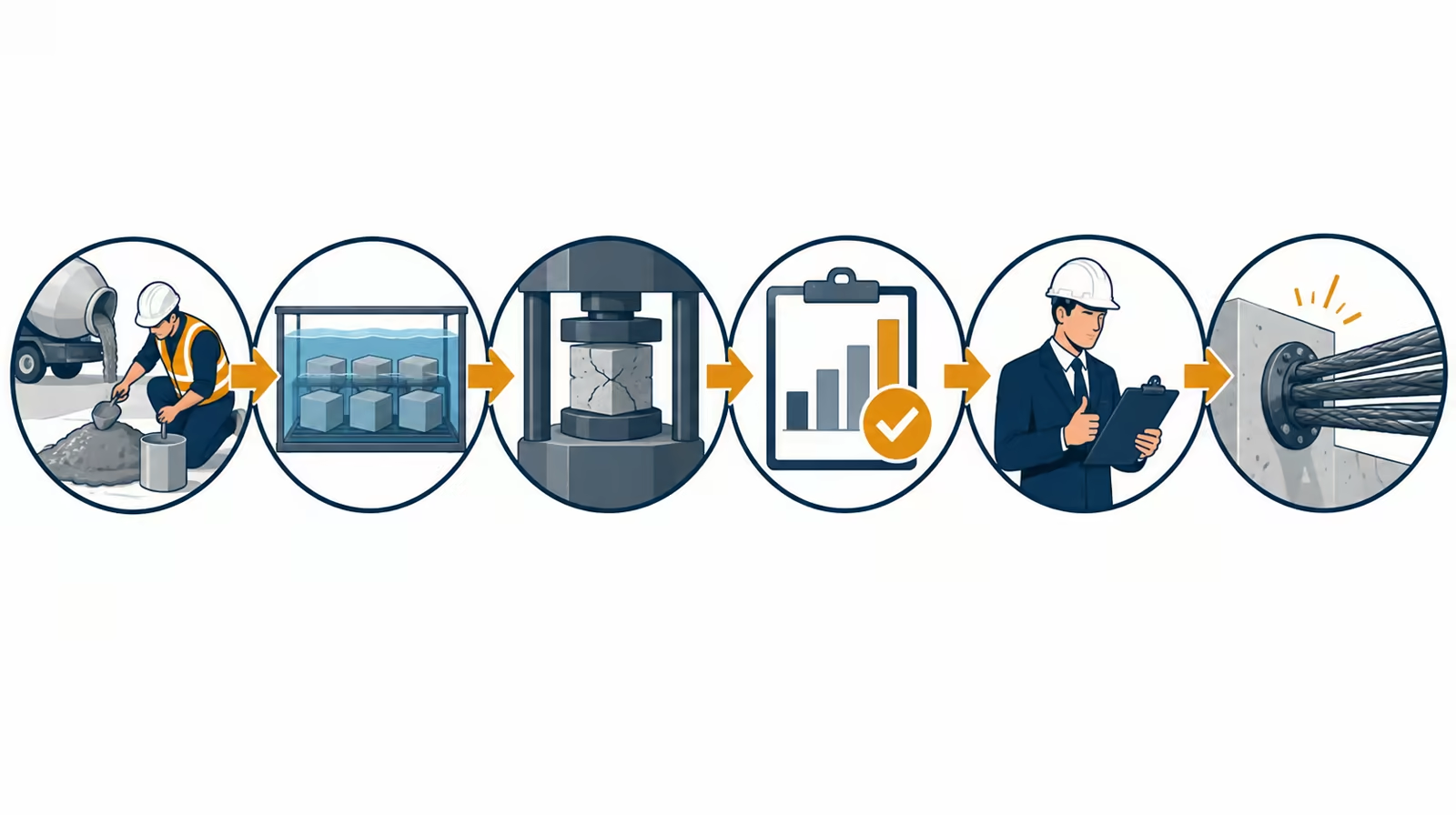
The sign-off chain: cast, cure, test to transfer strength, stress under witness, and sign off on the combined evidence.
What Is the Consultant Actually Approving?
More than people assume, and it is worth being precise, because a consultant asked to sign something usually wants to know exactly what they are signing.
At the pre-pour stage, that tendon profiles, chair spacings, anchorage positions and cover match the approved shop drawings.
At the transfer stage, that the concrete has reached the specified strength, on the evidence of cubes that genuinely represent the slab.
At the stressing stage, that every tendon was stressed to the specified force and that measured elongations agree with calculated ones within tolerance, with any variance explained.
After grouting, that the ducts were filled, on the evidence of volumes and grout cube results.
Each of those is a discrete piece of evidence about a discrete question. Together they are the reason a post-tensioned floor can be verified more completely than most structural work.
How Does This Affect the Programme?
It makes the floor cycle dependent on a laboratory result, which is a different kind of dependency from the ones a contractor is used to managing.
The practical responses are straightforward. Cast enough cubes, including spares, so a single mishandled sample does not stall a floor. Cure the transfer cubes properly and with the slab. Agree the transfer strength at the start of the project rather than discovering the requirement at the first pour. Book the testing so results arrive when they are needed. And set the stressing date against the expected transfer result, with the understanding that it moves if the concrete is not ready.
Handled that way, the testing regime costs almost nothing in programme. Handled reactively, it becomes the reason a floor cycle slips, and the delay gets recorded against post-tensioning.
Cube testing and quality control appear as a defined part of the scope of work in our project contracts, alongside design, supply, installation, stressing and grouting, rather than being left to another party. The full sequence from design through to testing and documentation sits with one company.
See how this plays out across our post-tensioning work across the UAE.