
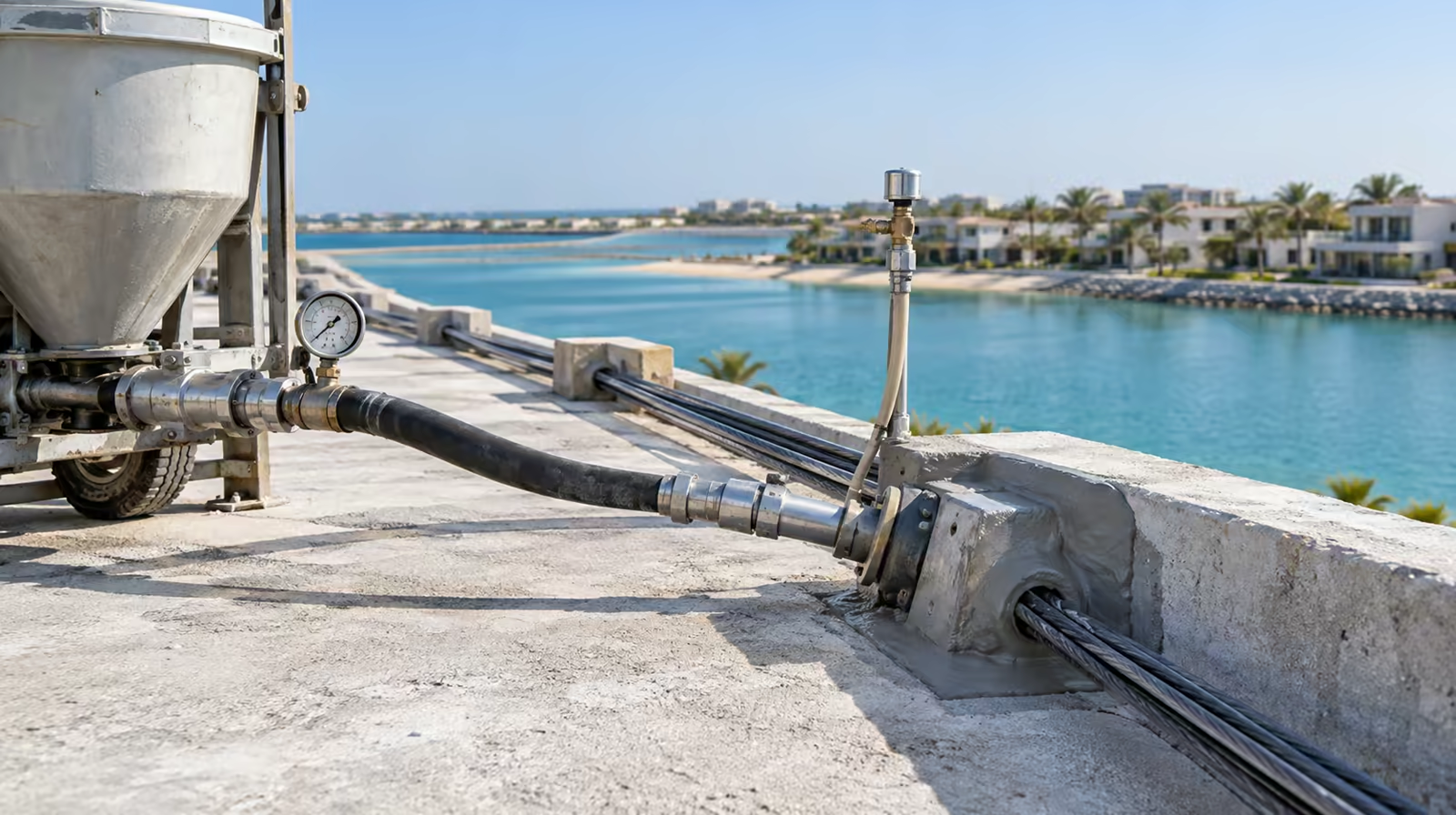
On a commercial project, a consultant witnesses the stressing, records go into a handover file, and a facilities team inherits a building with documentation.
On a private house, usually none of that happens. There may be no consultant attending the works. There is rarely a handover file in any meaningful sense. Nobody will inspect the structure again, and the person who ends up living with it for the next forty years was not watching when the grout went in.
That is what makes protection matter more on a coastal home rather than less, and it is the opposite of what most people assume about small buildings.
Why Does Grouting Carry More Weight on a House?
Because it is the one thing that cannot be checked afterwards, on the building type least likely to be checked at all. Our guide to the grouting procedure covers how the operation works; this post is about what changes when the building is a private home.
Grouting is the permanent corrosion protection for every tendon in the slab. It is placed once, inside a sealed duct, and it is either complete or it is not. A void leaves bare high-tensile steel in an enclosed humid space, which is exactly the environment corrosion needs.
On a commercial structure there is at least a chain of people who might notice: a consultant witnessing, records reviewed, a facilities team with a maintenance regime. On a villa there is often nobody in that chain. The homeowner is not going to review a grout volume record, and in most cases one was never produced.
Add a coastal position, where humidity and airborne chlorides are working on the structure continuously as we cover in our piece on protecting post-tensioned structures in a coastal climate, and the margin for a poorly executed grouting operation is smaller than on almost any other building type.
And the timeline is longer
A developer holds a building until it sells. An institution holds it for decades with a maintenance budget. A family holds a house indefinitely, often passing it on.
Nobody in that sequence is checking the tendons. The structure has to be right when it is built, because for a private home there is realistically no other opportunity.
What Should a Homeowner Actually Ask For?
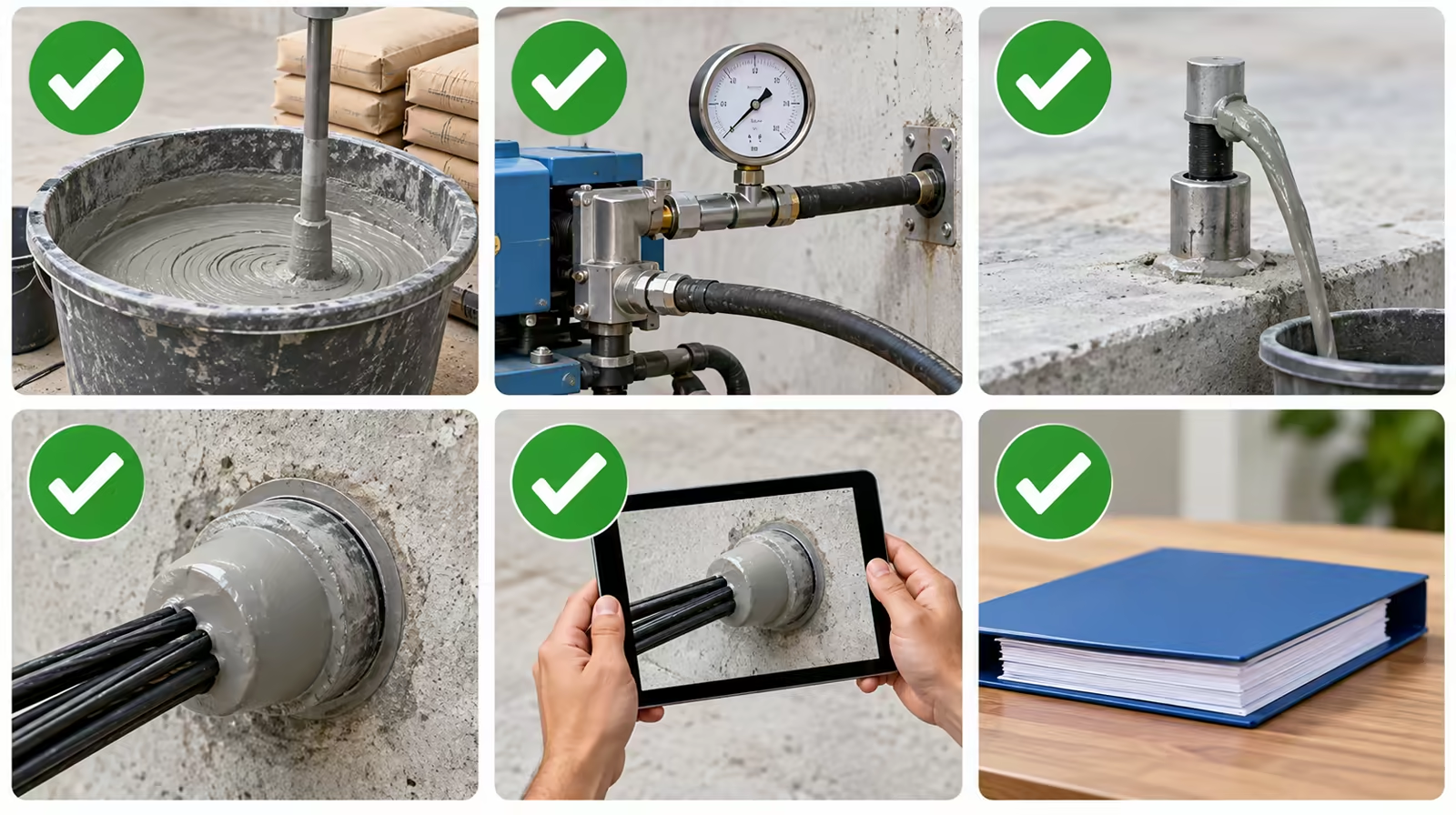
Five things. None is unreasonable, all are ordinary practice on a commercial project, and asking for them is the single most effective thing a private client can do.
Grouting carried out promptly after stressing. Not weeks later. Between those two operations the tendon sits unprotected in a duct open at the anchorages, on an open site, in coastal air.
The grout mix not adjusted on site. Adding water to make a stiff mix pump more easily is the most damaging shortcut available on this operation, and it directly produces the bleed and shrinkage that leave voids. It is also invisible in the finished slab.
Volumes recorded and compared. The quantity of grout actually pumped, set against the calculated duct volume. This is a simple comparison and it is the best available evidence that the ducts filled. If the numbers roughly agree, that is meaningful.
Anchorage pockets properly sealed. The anchorages at slab edges are the most exposed part of the system and the first place a coastal structure shows problems.
A copy of the records. Elongation figures from stressing, grout volumes, and cube results, in the same way we set out in our piece on cube testing and consultant sign-off. Ask for them at the outset, not at the end.
Why the Records Matter to a Homeowner Who Will Never Read Them
This is the point that seems least relevant and turns out to matter most.
A homeowner is unlikely to interpret an elongation record, and that is fine. The records still serve three purposes.
They change how the work is done. Documentation that will be handed over is produced during the operation. Documentation nobody expects is often produced afterwards, or not at all. Asking for the records changes the behaviour, not just the paperwork.
They answer a question years later. If a crack appears in year fifteen, or the house is extended, or a buyer's surveyor asks about the structure, the records are the difference between an answer and an investigation. Investigation on an occupied house means scanning, opening up and testing.
They protect the sale. A post-tensioned house with complete structural documentation is easier to sell than one where nobody can say what is in the slab. That is worth real money at the point of transaction and costs nothing to arrange during construction.
What Maintenance Does a Coastal Home Actually Need?
Very little, done consistently, and none of it requires a specialist.
Keep the drainage clear. Standing water on a terrace or against a slab edge has time to find a way in. This is the single most effective maintenance action on any coastal structure and it costs nothing.
Look at the slab edges once a year. Rust staining bleeding from a slab edge or an anchorage position is the earliest reliable warning available, and it is visible without equipment — the same signs we describe in our piece on signs a post-tension slab needs investigation.
Treat the waterproofing as a consumable. Every waterproofing system has a life considerably shorter than the structure's. On a terrace or a flat roof, it will need renewing at some point, and treating it as permanent is how a sound structure develops a problem.
Photograph anything you are unsure about, with the date. A crack that has not changed in five years is a different thing from one that has grown. Without a record nobody can tell which it is.
Never drill or core into the slab without locating the tendons first. This one is not maintenance advice, it is safety advice, and it applies to every future contractor who ever works on the house: air conditioning, a pool, a staircase, an extension. A post-tensioned slab is not a slab you can drill into casually, and the person who needs to know that is usually not present when the decision is made.
That last point is worth telling whoever maintains the house, not just knowing yourself.
On our projects grouting sits within the same scope as design, installation and stressing rather than as a separate package, and the records are produced as the work happens rather than compiled afterwards. On a commercial job that is good practice. On a private house it is closer to the only protection the owner has, because there is usually nobody else in the chain checking. For coastal homes, see our page on post tensioning in Umm Al Quwain.
Common Questions About Protecting a Post-Tensioned Home
Why does grouting matter so much on a private house?
Because it is the permanent protection for the tendons, it cannot be inspected or redone afterwards, and on a private house there is usually no consultant witnessing the work and no maintenance team who will ever look at the structure again.
What should a homeowner ask their contractor for?
Grouting promptly after stressing, no adjustment of the grout mix on site, grout volumes recorded against calculated duct volumes, properly sealed anchorage pockets, and a copy of the stressing, grouting and cube test records.
Do I need the records if I will never read them?
Yes. Asking for them changes how the work is documented, they answer questions years later without investigation, and they make the house easier to sell.
What maintenance does a coastal post-tensioned home need?
Keep drainage clear, look at the slab edges annually for rust staining, renew the waterproofing when it reaches the end of its life, photograph anything uncertain with dates, and never allow drilling or coring into the slab without locating the tendons first.
Building or Living in a Post-Tensioned Home on the Coast?
If you are building, tell us about the house and we will set out what protection it needs and what records you should receive. If you already own one and something is worrying you, send photographs and any drawings that still exist. We are close by, and looking is straightforward. See our companion article on designing villas and coastal homes in Umm Al Quwain for the design side of this question.