
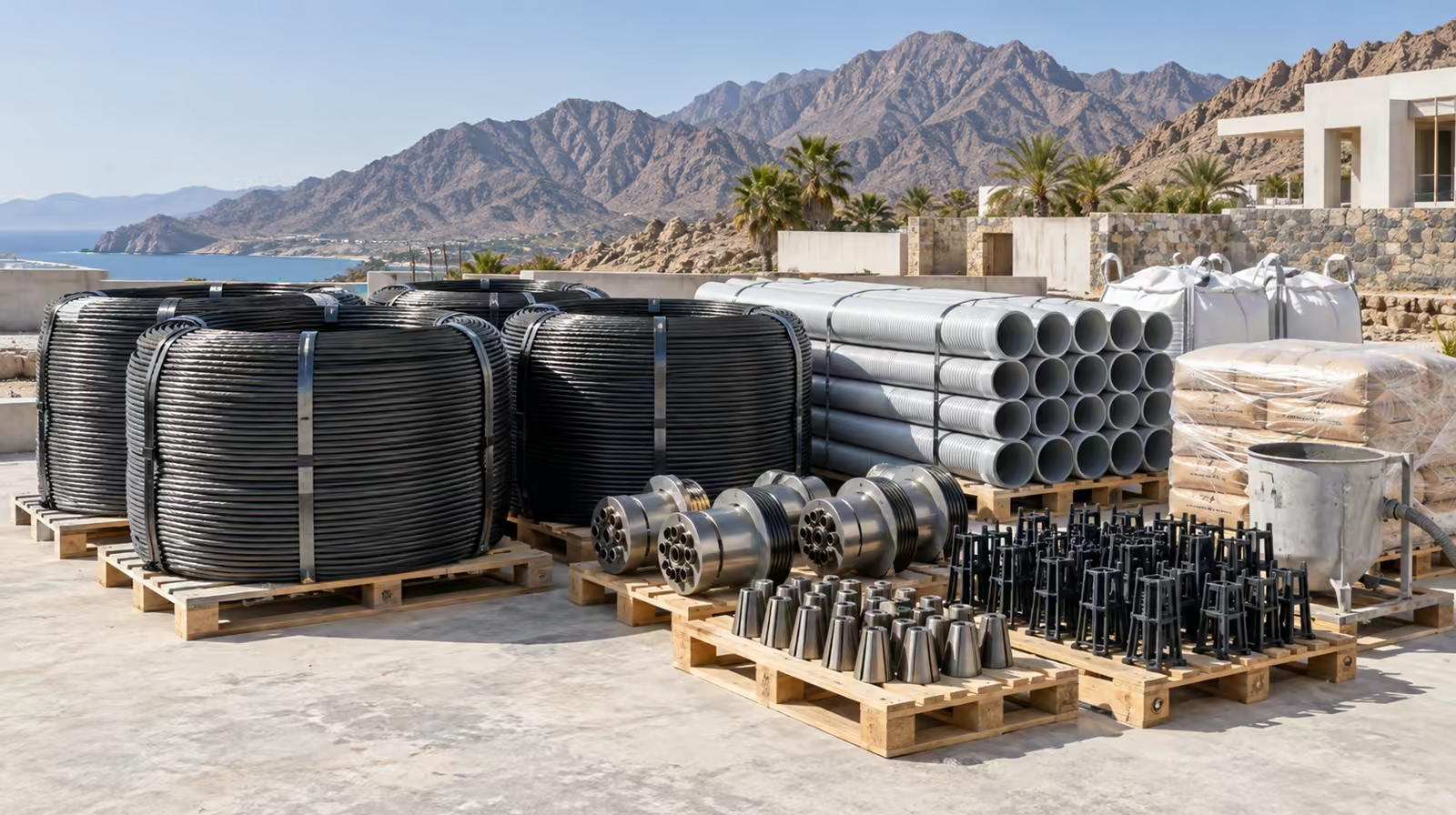
A post-tensioned villa slab contains a genuinely small amount of material.
For a single large room, perhaps a few hundred metres of strand, a handful of anchorages, a corresponding length of duct and a modest quantity of grout. It would fit in a pickup truck. The whole material content of the operation is smaller than the reinforcement for the same slab.
That smallness is the interesting part, and it is the source of nearly every practical difficulty on a villa project. Small orders are awkward to procure, easy to get wrong, and expensive to correct when the site is on the far side of a mountain range — a threshold we set out in our piece on villa post-tensioning in Fujairah.
What Does a Villa Slab Actually Need?
Four components, the same four in any post-tensioned element, in quantities that are unusual only in being small. Our guide to post-tension slab materials covers what each one does and how it fails; here we're concerned with quantity and delivery at villa scale.
Strand. Seven-wire prestressing strand, most commonly 12.7mm. The quantity follows from the tendon schedule: the number of tendons, their lengths, and the number of strands in each. On a villa this is a defined and modest figure rather than a bulk order.
Anchorages and wedges. One anchorage assembly at each end of each tendon. On a villa that is a countable number, and every one has to be the matched component for the strand in use.
Duct. Flat oval duct on a slab, in a length corresponding to the tendons, with the connections and vents needed along it.
Grout. A cement-based mix in a quantity following from the duct volume, plus a working allowance.
The order is small enough that it can be listed on a single page. That is exactly why it needs to be right.
Why small orders are harder rather than easier
Minimum quantities. Strand is produced and supplied in coils. A villa may need a fraction of one. Duct and grout have their own supply units. The practical consequence is that some materials will be ordered in larger quantities than the project consumes, and the project pays for the difference. That is normal and worth stating rather than discovering.
No margin for error. On a building project, an error in the take-off is absorbed by the next floor's delivery. On a villa there is no next floor. A shortfall of a single anchorage stops the operation until another arrives.
Delivery economics. Transporting a small load to a distant site costs nearly what transporting a larger one does. On a Fujairah project, separated from the rest of the country by the Hajar mountains, that is a real line rather than a rounding error.
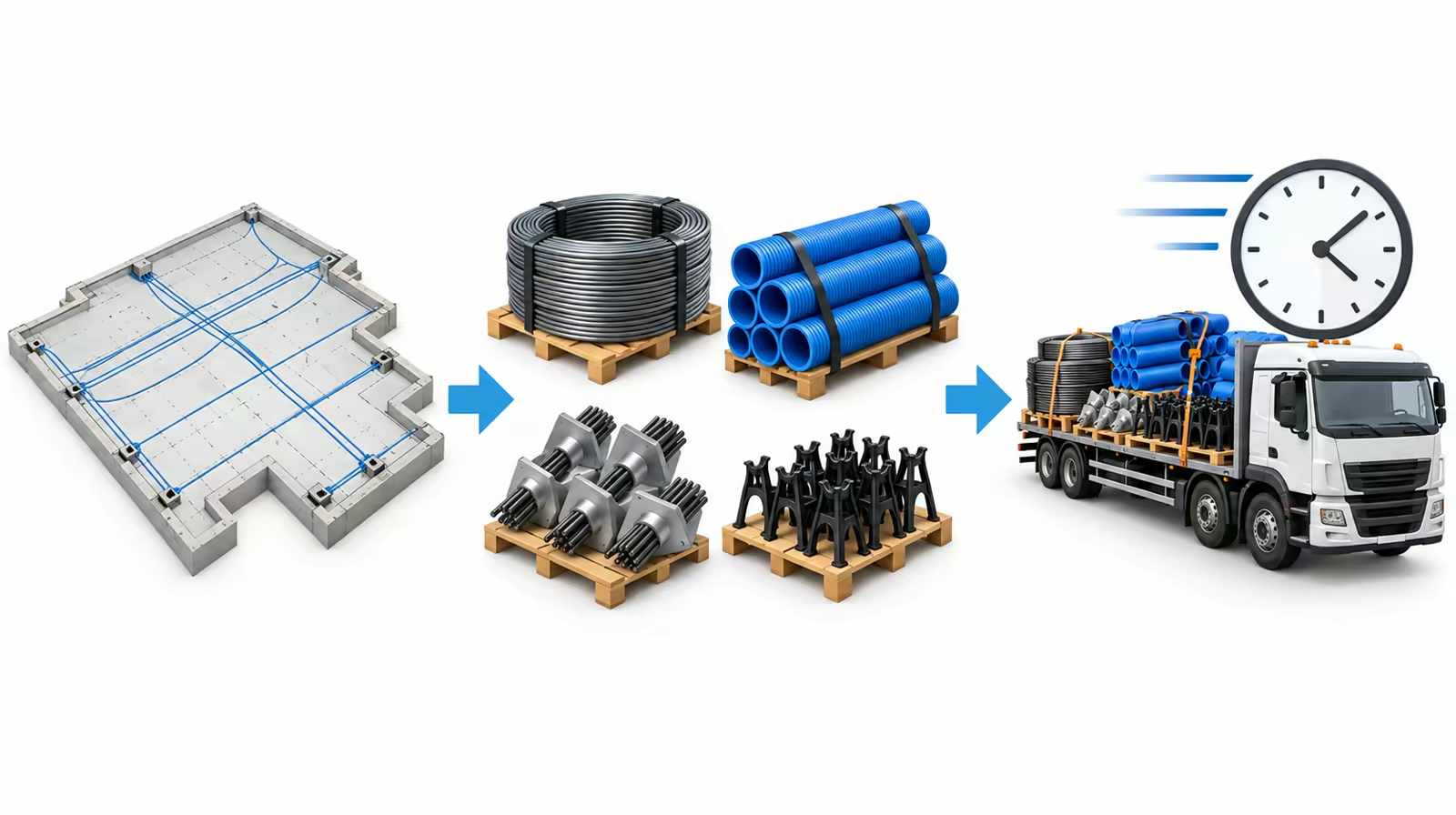
Why the Tendon Schedule Matters More Here Than Anywhere
Because it is the whole order, and there is no second chance to correct it.
On a multi-floor project, the schedule for the first floor is checked against reality on site and the later floors benefit from what was learned. A villa has one slab, so the schedule has to be right before anything is dispatched.
That puts weight on the take-off being done from the actual drawings rather than estimated. It also means the schedule should include the small things that get forgotten: the extra strand length needed at live ends for the jack to grip, the vents along the duct, a working allowance on grout, and a small spare quantity of wedges, which are the component most likely to be dropped, damaged or lost on a site.
A spare set of wedges costs very little and prevents the specific failure mode where a whole operation waits on a component the size of a thumb.
What Should Arrive, and in What Condition?
Strand with mill certificates matching the specified grade and diameter, free of pitting, coiled and protected.
Anchorages and wedges as matched components, castings undamaged, wedges clean with undamaged gripping teeth, ideally still in sealed packaging.
Duct undamaged and sound, with the correct connections and vents.
Grout to the specified mix, within date, in sound packaging.
On a coastal site — and much of Fujairah's villa development sits close to the coast — the storage conditions matter as much as the delivery condition, for the same reasons we cover in our piece on protecting post-tensioned structures in a coastal climate. Covered, off the ground, and for as short a period as possible. A villa site is often less organised than a commercial one, with no dedicated compound, which makes this worth agreeing rather than assuming.
How Does This Change What You Should Ask For?
A take-off from the drawings, not an estimate from floor area. On a small project the difference between a good take-off and a rough one is a larger proportion of the total than it would be on a building.
Supply and installation from the same party, if possible. On a villa this matters more than on a building. When one party owns the schedule, the order, the delivery timing and the installation, there is nobody to disagree with about what should have arrived. When materials are procured separately on price, a mismatched wedge or a missing vent becomes a dispute conducted at distance while the slab waits.
All the villa's post-tensioned elements scheduled together. If the living space, a cantilevered terrace and a roof slab all need it — the kind of layout we describe in our piece on villas with large open spans — one schedule and one delivery serves all three. Splitting them means paying the delivery and mobilisation cost repeatedly.
Clarity about what happens to surplus. Where minimum order quantities exceed what the project uses, it is worth knowing in advance who holds the balance and whether it is credited.
Across our Ajman projects, the material specification has consistently been 12.7mm pre-stressing strand with flat slab anchorages and smooth flat duct, and supply sits inside the same scope as design, installation, stressing and grouting. On a building that integration is convenient. On a single villa slab at distance, it is closer to essential, because there is no second delivery to correct the first.
Common Questions About Villa Post-Tensioning Materials
How much material does a post-tensioned villa slab need?
Considerably less than people expect. For a single large room, a few hundred metres of strand, a small number of anchorages, a corresponding length of duct and a modest quantity of grout.
Why are small post-tensioning orders difficult?
Because of minimum supply quantities, no margin for a take-off error, and delivery costs that do not scale down. A missing anchorage on a villa stops the operation, where on a building it would be absorbed by the next floor's delivery.
What is most often forgotten from a villa tendon schedule?
The extra strand length needed at live ends for the jack, vents along the duct, a working allowance on grout, and spare wedges. Wedges are small, easily damaged or lost, and a whole operation can wait on one.
Should materials and installation come from the same supplier?
On a villa, ideally yes. One party owning the schedule, order, delivery and installation removes the interface where a mismatched or missing component becomes a dispute while the slab waits.
Need Materials Scheduled for a Villa Slab?
Send the structural drawings, or the architectural plans with the spans if the design is not final, and we will take the quantities off them. If the villa has more than one post-tensioned element, send all of them, since scheduling them together is worth more than pricing them separately.