
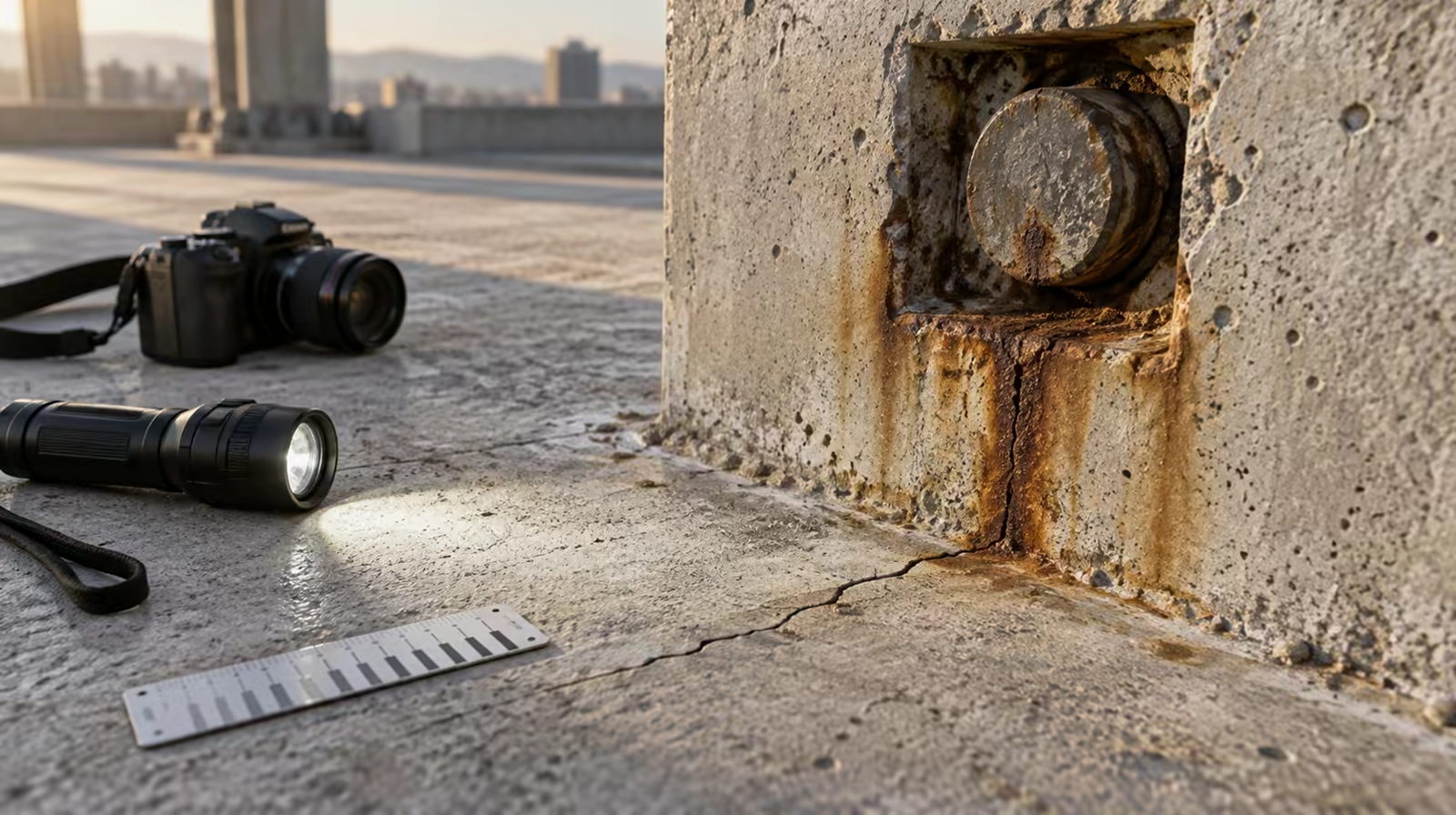
Two things are true at once about cracks in post-tensioned slabs, and most advice only tells you one of them. Fine cracks appear in almost every concrete structure ever built and mean nothing. But post-tensioned structures also have failure modes conventional reinforced concrete does not, which is why owners across the UAE benefit from knowing what to act on and what to leave alone.
What Should You Act On Immediately?
Three things. If you see any of them, stop reading and make the call.
Exposed strand. Prestressing strand visible anywhere: at a slab edge, in an anchorage pocket, through spalled concrete on a soffit. That strand is under enormous force and it is unprotected. Do not touch it, do not attempt to cut or clean it, and keep people away from the area, particularly from directly in front of an anchorage.
A blown-out anchorage pocket. Concrete broken away at a slab edge where an anchorage sits, sometimes with the anchorage or a strand tail protruding. This means force that should be contained is not being contained.
Sudden visible deflection. A soffit that has noticeably dropped, or a floor that has developed a sag, over a short period rather than gradually. Gradual deflection over years is a serviceability question. Sudden movement is a structural one.
None of these is common. All of them justify immediate specialist attention rather than an email and a wait.
What Warrants Investigation Without Being an Emergency?
Rust staining, particularly at slab edges. Brown staining bleeding from an anchorage pocket or a slab edge suggests moisture has reached steel that should be protected. It is one of the most reliable early indicators of a corrosion problem, and it is visible from ground level with no equipment. Investigate it while it is a stain rather than waiting for it to become a spall.
Cracks that follow a pattern. A single random crack is usually nothing. Cracks running consistently along the line of the tendons, or clustered around anchorages, or repeating in the same position on multiple floors, are telling you about something systematic rather than local.
Cracks that are widening. Width matters less than change. A crack that has been the same for five years is stable. One that has grown measurably in six months is doing something.
Deflection that keeps increasing. Some long-term deflection is expected as concrete creeps. Deflection that continues to increase well beyond the first few years suggests the slab is not carrying what it was designed to.
Water ingress through the slab. Anywhere water is finding a path through a post-tensioned floor, it is finding a path toward the tendons.
Spalling or delamination. Concrete breaking away or sounding hollow when tapped, especially on a soffit or near an edge. Often the visible stage of corrosion that started well before.
And the ones that usually turn out to be nothing
Fine surface cracking in a regular pattern, common as concrete shrinks. Cracks that appeared early and have not moved since. Hairline cracking at re-entrant corners and around openings, where stress naturally concentrates. Minor variations in soffit level that have always been there.
These are worth recording so that change can be detected later, but they do not by themselves indicate a problem. Being told everything needs investigating is as unhelpful as being told nothing does.
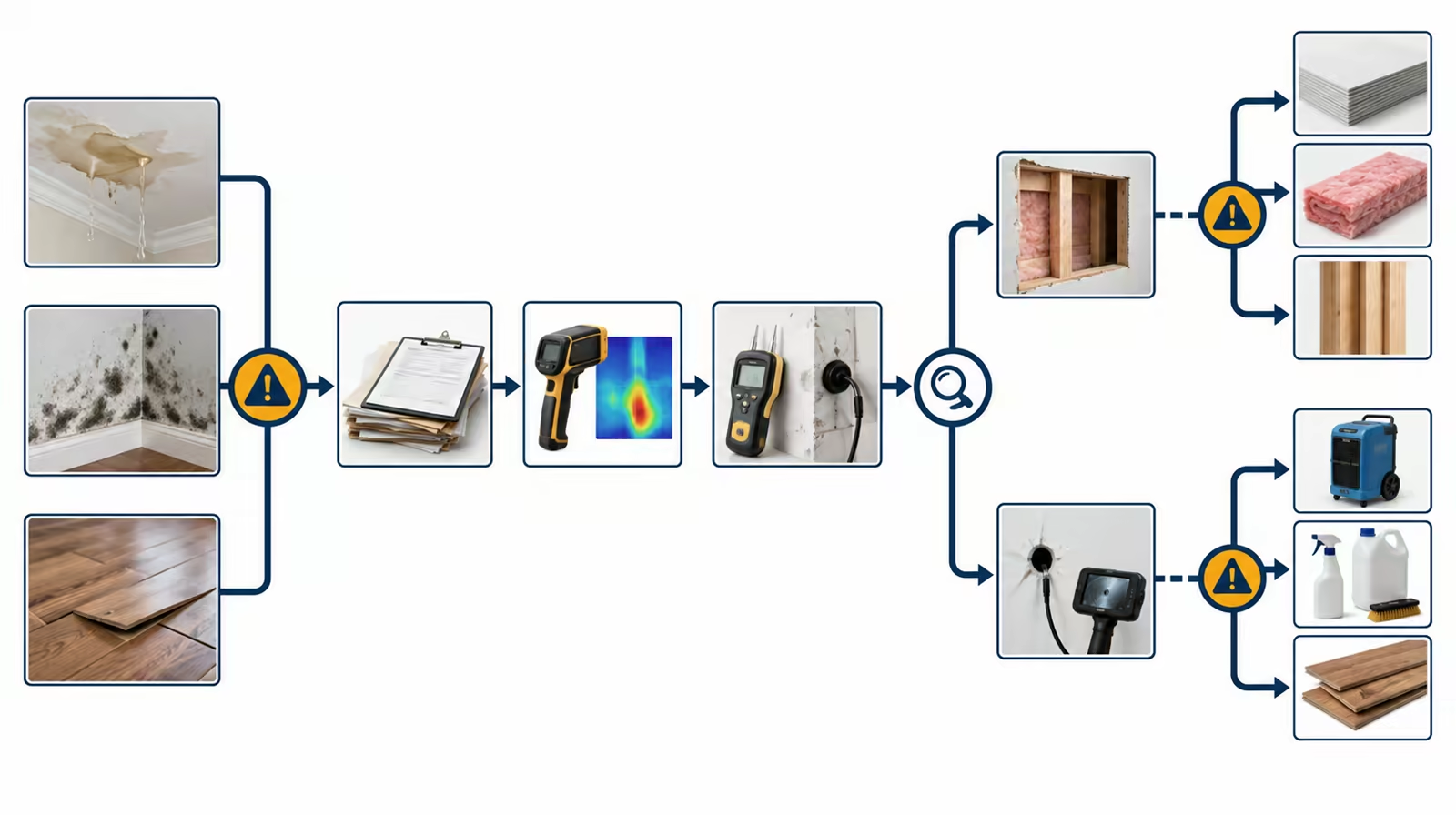
A triage, not a checklist: act now, investigate, or record and monitor.
Why Post-Tensioned Structures Need a Different Approach
Because of what the steel is doing and how it fails.
Ordinary reinforcement corrodes gradually and gives warning: rust expands, concrete cracks and spalls, and the deterioration is visible long before capacity is meaningfully affected.
Prestressing strand is different. It sits at very high stress inside a duct that is supposed to be sealed, and it is more susceptible to corrosion mechanisms than ordinary reinforcement is. Deterioration can progress inside the duct with little external sign, and a tendon failure is abrupt rather than gradual.
Conditions across the UAE accelerate this. Most building here happens within a few kilometres of the coast, in an environment combining high humidity, airborne chlorides and, in many areas, saline groundwater. A post-tensioned structure in Ajman, Sharjah or Ras Al Khaimah faces a more aggressive exposure than the same building would inland or in a temperate climate. It is also relevant that much of the country's post-tensioned building stock is young, twenty years old or less, so early signs are appearing on buildings whose owners have not yet had reason to think about them.
There is a second difference that matters for anyone doing work on such a building. Never cut, core or drill into a post-tensioned slab without first establishing where the tendons are. Cutting a tendon under load is dangerous to whoever is doing it and structurally significant to the building. Related searches on post-tension slab drilling are common precisely because this comes up constantly on refurbishment and fit-out work, and it is the single most important thing for a non-specialist to know.
What Does Investigation Actually Involve?
It escalates, and a competent investigation starts at the cheap end.
Documents first. Original drawings, tendon layouts, stressing records, grouting records. If they exist, a great deal can be established before anyone visits, the kind of evidence covered in our guide to elongation records. Their absence is itself informative, and unfortunately common.
Visual survey. Systematic recording of what is visible: crack positions, widths and patterns, staining, spalling, and the condition of anchorage zones. Photographed and located so it can be compared against a future survey.
Locating the tendons. Establishing where tendons actually run, which matters both for the assessment and for any subsequent work on the structure.
Targeted opening up. Where the visible evidence justifies it, small openings at specific locations to inspect the duct and strand directly, a step that falls under inspection and testing. This is invasive and is done sparingly, at points chosen from what the earlier stages found.
Assessment. What the structure can currently carry, whether it is deteriorating, and what the options are, the starting point for any post tension repair and rehabilitation work.
A first response that skips to opening up the slab without reading the documents or surveying the visible evidence is usually the more expensive route, not the faster one.
Most post-tensioning defects originate during construction rather than in service: a duct left ungrouted, a void where bleed water receded, a tendon damaged during a pour, water reaching an anchorage that was never properly sealed. That is one reason our assessment of an existing structure starts with what should have happened during construction and looks for where it did not. Our own new-build work is in Ajman and across the UAE, on buildings of exactly the type most of the region's post-tensioned stock consists of.
See how this plays out across our post-tensioning work across the UAE.