
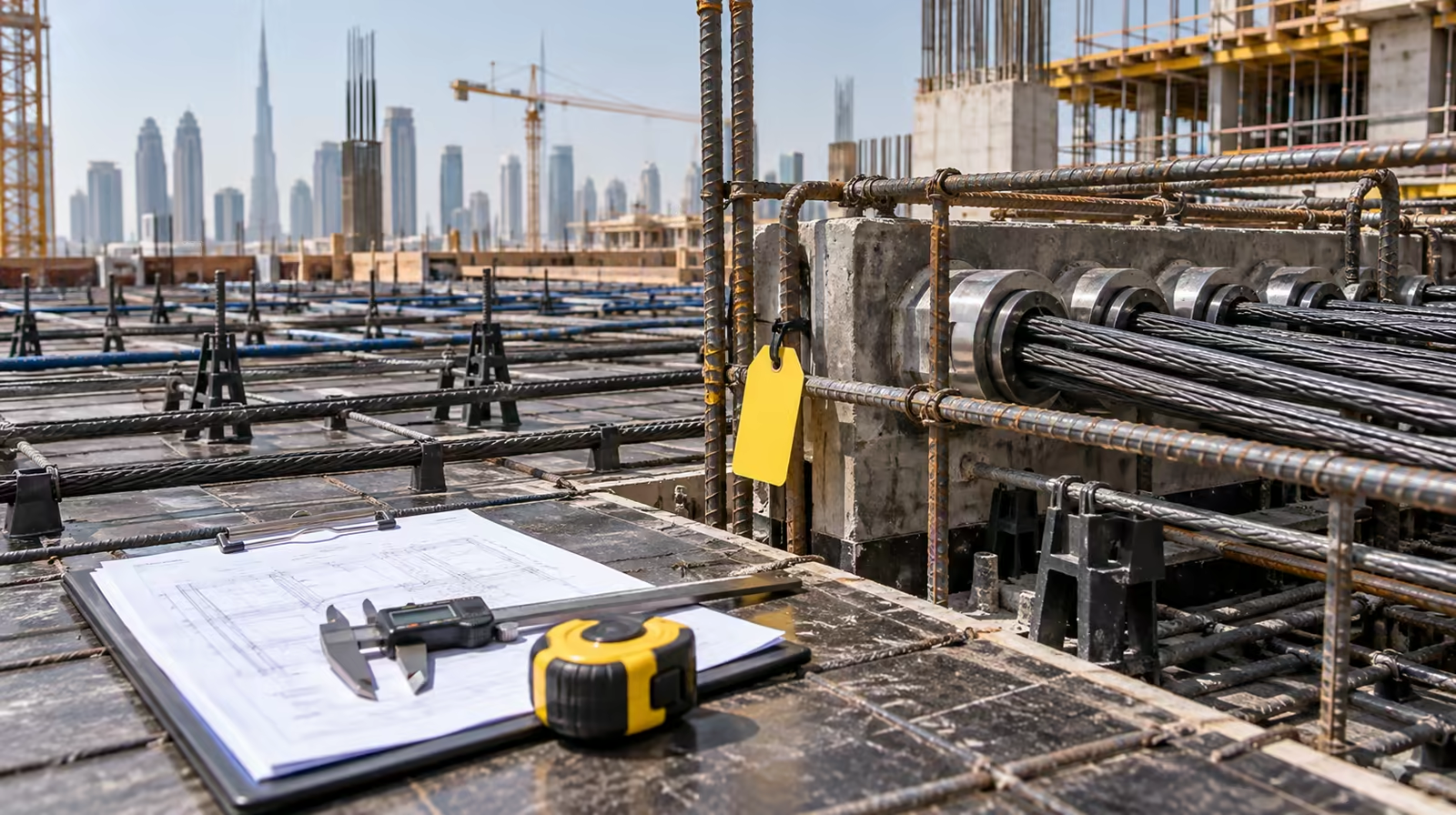
Most of the critical work on a post-tensioned floor is hidden almost immediately: tendon profiles disappear under concrete within hours, grouted ducts are sealed permanently. Across projects in the UAE, the window in which anything can be verified by looking is very short, which is exactly why independence matters once it closes.
What Does Independence Actually Add?
Not competence. The contractor's own team is frequently more expert in their trade than any inspector.
What it adds is that the person confirming the work has no stake in the answer.
That distinction matters in a specific way on a post-tensioned structure. Most of the critical work is hidden almost immediately: tendon profiles disappear under concrete within hours, grouted ducts are sealed permanently. The window in which anything can be verified by looking is very short, and once it closes the only remaining evidence is documentary.
If all that documentation was produced by the party who did the work, it is still probably accurate. But it rests entirely on that party's diligence, and there is no independent check on it anywhere in the chain. For a floor that a building depends on for sixty years, that is a thin evidential base.
The situation this actually protects against
Not fraud, which is rare. Ordinary human error under programme pressure, which is not.
A tendon profile checked at the end of a long shift by the person who installed it. A grouting record completed from memory after the operation rather than during it. An out-of-tolerance elongation recorded as within tolerance because the alternative was stopping a floor cycle and someone was reasonably confident it was fine.
None of those requires bad intent. All of them are much less likely when a second party is present whose only job is to look.
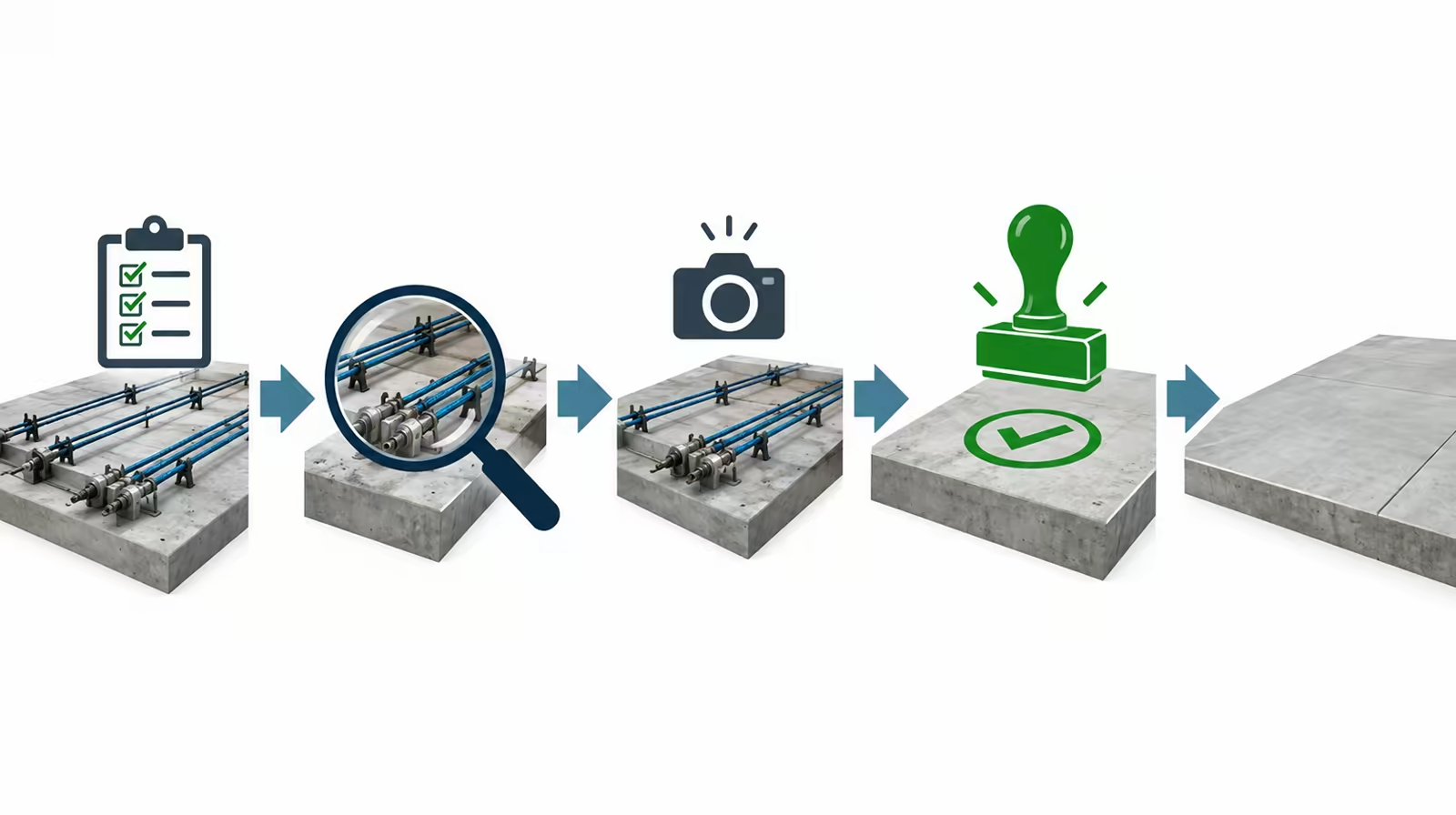
The four hold points where independent verification adds the most: pre-pour, stressing, grouting, and documentation.
What Would a Third Party Actually Check?
The same hold points the work already has, witnessed independently.
Before the pour. Tendon profiles against the approved drawings, chair spacings, anchorage positions, cover, and duct condition, the same checks covered in our guide to tendon installation. This is the highest-value moment for an independent eye, because it is the last point at which anything can be corrected cheaply.
At stressing. That the concrete strength evidence supports proceeding, that the jack is calibrated, that forces and elongations are recorded as measured, and that variances are investigated rather than absorbed.
At grouting. Volumes pumped against theoretical duct volumes, consistency at the vents, and grout cube sampling.
On documentation. That the records are complete, internally consistent, and traceable back to specific locations in the structure.
On an existing building, the scope is different. Verification there means establishing what is actually present: locating tendons, assessing condition, and identifying whether the structure matches whatever drawings exist.
When Is It Genuinely Worth Commissioning?
Not on every project. Being straightforward about that is more useful than recommending it universally.
Where the consequences are highest. Transfer structures, podium slabs carrying towers, long spans over occupied space, structures with an unusual number of people above or below them.
Where the post-tensioning is subcontracted through several parties. Each handover is a point where responsibility blurs, and independent verification restores a single point of accountability.
Where the client will not be the long-term owner. A developer selling a building is handing over a structure someone else will live with. Independent records materially strengthen that handover and tend to help in due diligence.
Where something has already gone wrong. If an elongation pattern looked odd, if a pour was disrupted, if there is a dispute about what happened on a particular floor, an independent assessment is how it gets settled.
Where the building is changing use. Converting a floor to a heavier occupancy means establishing what the structure can actually carry, which means knowing what is actually in it.
For a straightforward residential building, competently delivered, with a consultant witnessing the hold points and complete records produced, additional third-party verification may add little. That is an honest answer.
Who Should Not Do It
The party who did the work.
This is worth stating plainly, including against our own commercial interest. Where we have delivered the post-tensioning on a structure, our records and our team are evidence, but our confirmation of our own work is not independent verification and should not be presented as though it were.
Independent verification means a party with no involvement in the original work and no relationship that would make an adverse finding awkward. Where we are asked to verify work carried out by others, that condition is satisfied. Where we are asked to verify our own, it is not, and the right answer is to say so and help find someone appropriate. Where verification does surface a problem, that is where repair and rehabilitation comes in.
Our inspection and testing work covers post-tensioned structures built by others as well as documentation of our own projects. Where investigation requires specialist scanning or non-destructive testing, we confirm at the outset what is carried out directly and what is brought in, so nobody is unclear about who is doing what.
See how this plays out across our post-tensioning work across the UAE.