
That is the difference height makes, and it is not a difference of degree. Tall buildings are built by repetition, which is exactly what makes them efficient and exactly what makes a systematic error expensive. The floor cycle that delivers a floor every seven days also delivers the same mistake every seven days.
What Does Repetition Do to a Small Error?
It multiplies it before anyone has the chance to catch it.
Consider a chair spacing that is slightly too wide, so tendons sag marginally below their intended profile between supports. On one floor that is a minor deviation, probably absorbed by the design margins. Nobody would notice it, and arguably nobody needs to.
Now run it for thirty floors. The same crew sets out the same way each cycle, because consistency is what makes a floor cycle work. Thirty floors later it is not a minor deviation, it is a characteristic of the building.
The same logic applies to a grouting practice that leaves occasional voids, an anchorage detail that consistently sits slightly too close to a slab edge, or a cube curing regime that is not quite representative. Individually trivial. Repeated forty times, systematic.
Which is why the first three floors matter more than the rest
The most valuable independent inspection on a tall building happens at the bottom.
By floor four, the crew has settled into a method and that method will run to the top. Whatever is checked and corrected in the first few cycles gets corrected for the whole building. Whatever is missed gets repeated for the whole building.
That is a genuinely useful scheduling insight. Independent inspection concentrated in the early cycles, then sampled thereafter, catches far more than the same number of visits spread evenly.
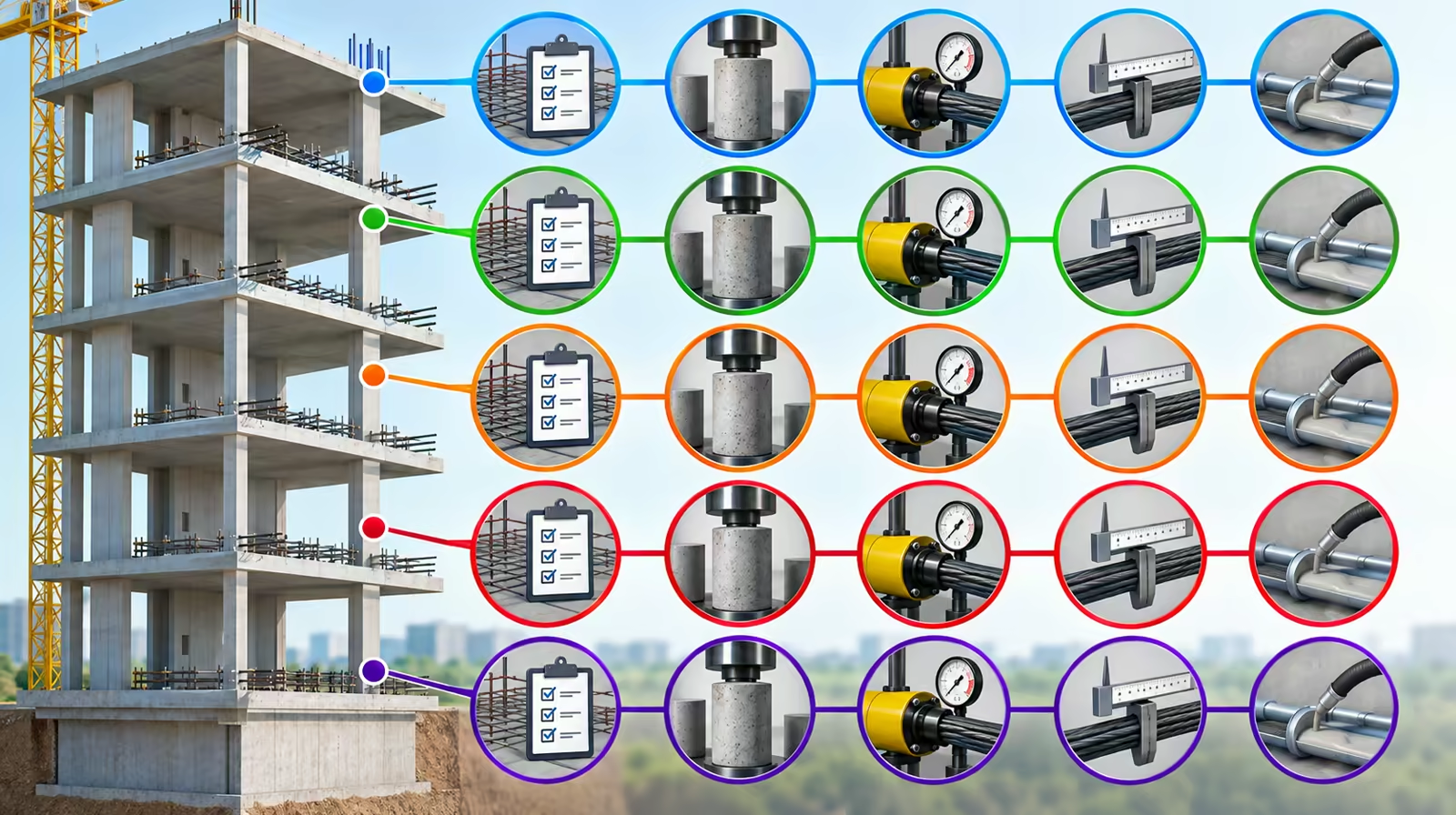
A method established in the first few floor cycles runs to the top of the building, for better or worse.
How Does the Contract Chain Change at This Scale?
It gets longer, and every additional link is a place responsibility can blur.
On a mid-rise building the chain is often short: developer, consultant, main contractor, post-tensioning specialist. On a large Dubai tower the arrangement is frequently more complex, with a management contractor, package contractors, a specialist subcontracted through another subcontractor, and design responsibility split between a design consultant and a specialist designer.
Every one of those handovers is a point where an assumption can be made on both sides and checked by neither. The classic version is documentation: everyone assumes someone else is collecting it, and at handover it turns out nobody was, the same gap covered in our guide to elongation record keeping.
Independent verification is not a comment on any of those parties. It is a single point of accountability laid across a structure that has several.
What Happens at Handover, and Why It Matters Here
This is the argument that carries most weight with a developer, and it is specific to how Dubai buildings are owned.
A residential tower is typically sold on. The developer does not keep it. Within a few years the building belongs to hundreds of individual owners, managed by an owners association, with a facilities management company responsible for maintaining a structure none of them saw being built.
Everything that association will ever know about the post-tensioning in their building is whatever was written down during construction. If it was recorded and handed over properly, a question in year twelve is answered from a file. If it was not, the same question requires investigation: scanning, opening up, testing, all in an occupied building, all expensive, all disruptive to the residents who now own it.
Independent verification during construction is the cheapest possible insurance against that outcome, and the party who benefits is not the one who pays for it. That is worth stating plainly, because it explains why it gets skipped.
Where Specifically Should It Be Concentrated?
Four points, in order of value.
The transfer structure. The single highest-consequence element in the building, carrying loads accumulated from every floor above, and built once with no opportunity for the error to be caught by repetition, the same element discussed in our guide to podium and transfer slabs. If only one element receives independent verification, this is it.
The first three floor cycles. For the reasons above.
Any change in method. A new crew, a different formwork system, a change of concrete supplier, a modified slab layout at a setback or refuge floor. Every discontinuity is a place where the established method stops applying.
The documentation itself. Not just the work but the record: complete, internally consistent, traceable to locations, and actually in the handover file rather than on a subcontractor's server.
What This Costs Relative to the Building
Very little, and the comparison is worth making explicitly because the decision usually gets made on cost.
Post-tensioning is a small percentage of a tower's construction value. Independent verification of the post-tensioning is a small percentage of that. Set against the cost of investigating a forty-storey building years later, with residents in place and no records to work from, the ratio is not close.
The reason it gets omitted is not that anyone judges it poor value. It is that the cost falls on the developer and the benefit falls on the owners association that does not yet exist.
Our inspection and testing work covers post-tensioned structures built by others as well as documentation of our own projects. Where we have delivered the post-tensioning ourselves, we can document it but cannot independently verify it, and we say so rather than presenting our own records as third-party assurance.
Explore our Inspection and Testing service, or see what to look for when comparing post tension companies in Dubai.